Equipment Breakdown and Supply Interruption for South Carolina Manufacturers: The Complete Guide to Machinery Failure, Contingent Business Income, Dependent Properties, Waiting Periods, and Costs
See How We're Different
or call us: 864-626-6181
Most equipment breakdown claims I've seen from South Carolina plants don't start with a catastrophe. They start with a $40 bearing, a tripped breaker on a press line, or a supplier in another state that quietly stops shipping. The physical damage is often modest. The lost production that follows is what hurts.
That gap between what breaks and what it costs is the reason this guide exists. Machinery failure, contingent business income, dependent properties, waiting periods, and premium costs all connect, and a weak spot in any one of them can leave a manufacturer paying out of pocket for weeks of idle payroll.
If you run a tier 2 stamping shop in Spartanburg, a plastics molder near Greenville, or a machining operation feeding the Lowcountry aerospace cluster, your exposure looks different from a general commercial property risk. Your revenue depends on machines that standard property forms often exclude, and on suppliers and customers you don't control. The sections below walk through how equipment breakdown and supply interruption coverage for SC manufacturers actually works, where policies commonly fall short, and what drives what you'll pay. The goal is simple: you should finish this able to read your own policy and ask your agent sharper questions.
Understanding Equipment Breakdown Risks in South Carolina Manufacturing
South Carolina's manufacturing base is concentrated and interdependent. The I-85 corridor runs on automotive supply, while Charleston County increasingly runs on aerospace. That concentration creates efficiency, and it also creates shared failure points.
Consider the scale of the anchor plants. Boeing is expanding its North Charleston campus to reach 787 production of 10 airplanes per month by the end of 2026, which concentrates more value and more supplier dependence at one site. Upstate, BMW's footprint shapes hundreds of smaller shops. Even with a $1.7 billion investment in its South Carolina facilities, the automaker reported a 35% year-over-year profit decline in Q2 2026, prompting warnings about possible production idling. If an OEM slows down, every supplier in its orbit feels it.
Downtime at the top of the chain is staggering. Large automotive plants now face unplanned downtime costs averaging $2.3 million per hour, roughly $638 per second. Your plant probably isn't losing money at that rate. That said, OEMs push those costs downstream through supply agreements, chargebacks, and lost contracts.
Here's what that means for you: an equipment failure in your facility is two problems at once. One is the repair bill. The other is the revenue gap, plus the contractual pressure from a customer who can't wait. Your insurance program needs to address both, and most standard property policies only partially touch either.
Core Coverage: Beyond Simple Machinery Failure
A common client misconception is that equipment breakdown insurance is "warranty coverage for old machines." It isn't. A well-written equipment breakdown form responds to sudden and accidental physical damage from internal causes, the things a property policy typically carves out. Wear and tear itself isn't covered, but the sudden failure that results from it often is.
A strong form usually includes:
- Direct damage to the machine, including repair or replacement
- Business income and extra expense tied to the breakdown
- Spoilage for temperature-sensitive materials, resins, or adhesives
- Expediting expenses for overnight parts and overtime labor
- Service interruption when a utility's equipment fails off-premises
- Hazardous substance cleanup after a breakdown releases contaminants
Mechanical Breakdown and Electrical Arcing
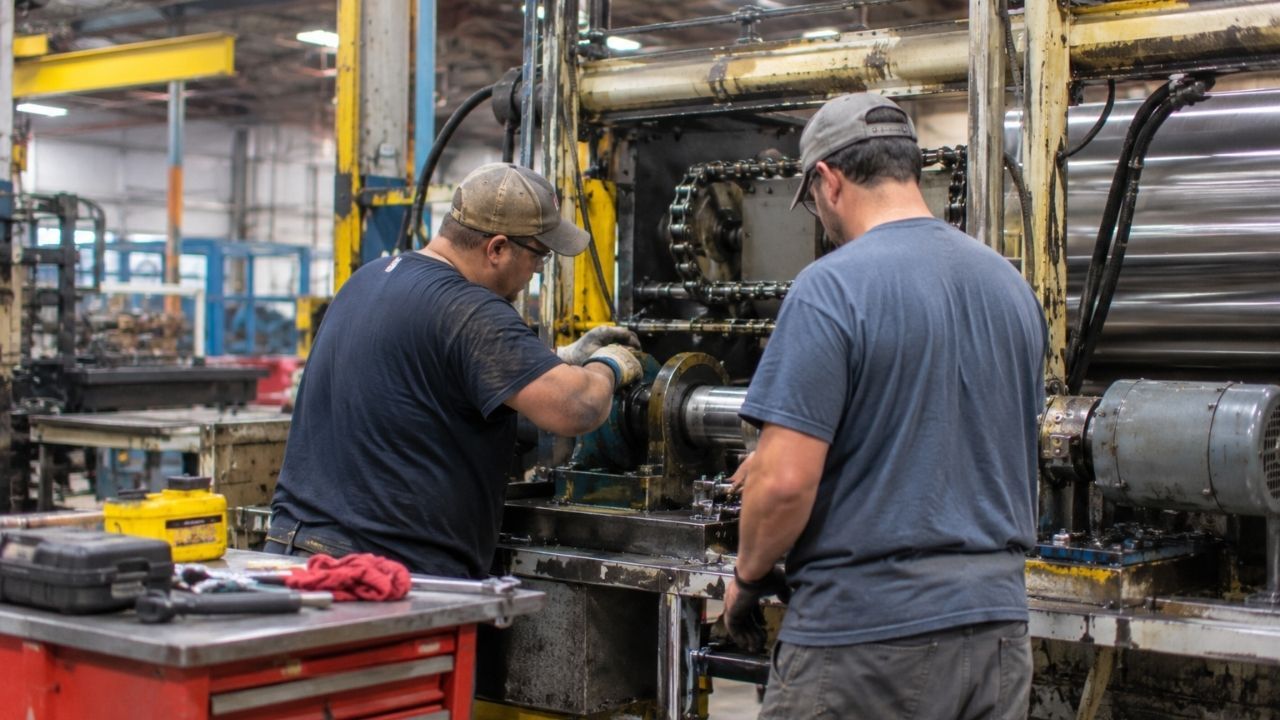
Mechanical breakdown covers events like a gearbox seizing, a spindle shattering on a CNC machining center, or a hydraulic pump failing on an injection molding press. Electrical arcing covers damage when current jumps across a gap inside switchgear, motors, transformers, or control panels. Property policies often exclude "artificially generated electrical current," which is exactly how many of these losses happen.
One Upstate claim scenario I see repeatedly: a summer storm causes a power surge, the main switchboard arcs, and a robotic welding cell loses its controllers. The property carrier argues about cause. The equipment breakdown carrier pays because arcing is squarely in its insuring agreement.
Boiler and Pressure Vessel Explosions
This is where equipment breakdown coverage started, and it still matters for plants running steam boilers, air receivers, autoclaves, and thermal oil heaters. Many property forms exclude explosion of steam boilers and pressure vessels you own or operate. South Carolina also regulates boilers and pressure vessels through state inspection requirements, and many equipment breakdown carriers perform those jurisdictional inspections as part of the policy. That inspection service has real value, since it can catch a failing safety valve before it becomes a claim.
Comparison: Property Insurance vs. Equipment Breakdown
The two policies are designed to fit together, not overlap. Property insurance covers external perils. Equipment breakdown covers what goes wrong inside the machine. Problems arise when one is missing or when the business income sections don't match.
| Coverage Element | Commercial Property | Equipment Breakdown |
|---|---|---|
| Fire, wind, hail | Covered | Not the focus |
| Mechanical failure | Usually excluded | Core coverage |
| Electrical arcing | Often excluded | Covered |
| Boiler explosion | Often excluded | Covered |
| Utility interruption | Limited or excluded | Commonly included |
| Spoilage | Narrow or none | Commonly included |
| Jurisdictional inspections | No | Often included |
| Business income trigger | Covered property peril | Covered breakdown |
The catch is the business income line. If your property policy has a 12-month period of restoration and your equipment breakdown endorsement has a lower sublimit or a shorter indemnity period, a long-lead-time machine failure can outrun your coverage. Custom presses, large CNC centers, and specialized furnaces can take many months to replace.
Ask your agent to confirm three things in writing: that business income limits match across both policies, that equipment breakdown applies to your production machinery and not just building systems like HVAC and electrical, and that the valuation basis is replacement cost rather than actual cash value. Older equipment valued at ACV can produce a check that won't come close to buying a modern equivalent.
Supply Chain Protection: Contingent Business Income and Dependent Properties
Your plant can be fully operational and still lose money because someone else's plant went down. Contingent business income (CBI) covers that scenario. It responds when physical damage at a "dependent property" interrupts your operations.
The financial stakes are significant. About 80% of manufacturing CEOs believe up to 20% of their revenue is at risk if their top three suppliers face a two-week disruption. And in 2026, 53% of surveyed manufacturers said they couldn't maintain operations for more than three weeks after a major supply chain shock.
Dependent properties fall into four categories:
- Contributing locations: suppliers who send you materials or components
- Recipient locations: customers who buy your output
- Manufacturing locations: contractors who make products for your customers on your behalf
- Leader locations: nearby businesses that draw customers to you (rare in manufacturing)
Protecting Revenue from Supplier Failures
If a sole-source supplier of specialty resin or forged blanks has a fire, your lines stop. CBI on contributing locations pays your lost income while they rebuild. The key word is "physical damage." Most forms require a covered peril at the supplier's site, so a labor strike, bankruptcy, or capacity shortage usually won't trigger coverage.
Watch for unnamed versus scheduled coverage. Many policies include a small blanket CBI limit for unnamed suppliers, which often runs far below your actual dependence. Schedule your critical suppliers by name with appropriate limits. A related gap: equipment breakdown at the supplier's plant may not count unless your CBI form specifically includes it.
Coverage for Downstream Customer Interruptions
This side gets overlooked constantly. If your largest customer's assembly plant is shut down by a covered loss, they stop taking your parts. Your machines are fine, but your revenue drops. Recipient location coverage addresses that.
For SC suppliers with heavy concentration on one OEM, this deserves close attention. A careful review should also confirm whether "tier 2" exposure is covered, meaning your supplier's supplier. Most forms limit coverage to direct dependencies unless you negotiate broader wording.
Navigating Waiting Periods and Time-Element Deductibles
A waiting period is a deductible measured in time instead of dollars. Business income coverage doesn't start paying until the waiting period expires. For a plant where a single shift of downtime costs serious money, the difference between a 24-hour and a 72-hour waiting period is a meaningful chunk of uninsured loss.
Equipment breakdown policies handle this in a few different ways:
- Hours-based waiting period: coverage begins after a set number of hours, commonly 24 or more
- Days-based waiting period: often seen on CBI and utility service interruption
- Dollar-equivalent deductible: expressed as a multiple of average daily value, such as "3 x ADV"
- Combined deductibles: a dollar deductible on direct damage plus a time deductible on income
The ADV approach trips up a lot of clients. Average daily value is generally calculated by dividing your projected annual business income by the number of working days. If you run seasonal peaks, a breakdown during your busiest month costs more than the averaged figure suggests.
Utility service interruption deserves its own look. Many forms impose a separate, longer waiting period before off-premises power loss coverage kicks in. During South Carolina's hurricane season, a grid disruption that lasts a day might fall entirely within that window. One thing to keep in mind: carriers will often shorten waiting periods for a modest premium increase, and that trade can make sense for continuous-process operations like chemical batching or textile finishing where restart itself takes hours.
Factors Influencing Policy Costs for SC Manufacturers
Premiums for equipment breakdown and contingent coverage aren't priced from a simple rate chart. Underwriters build them from the specifics of your operation. I'm not going to quote you a premium range, because the spread between two similarly sized plants can be wide enough to make any generic number misleading.
The main levers underwriters pull:
- Total insured values for equipment and business income
- Equipment types, with boilers, turbines, and large transformers rated differently than conveyors
- Business income limits and waiting periods selected
- CBI scheduling, including how many dependent locations and how concentrated they are
- Loss history, especially prior breakdown claims
- Deductible structure on both direct damage and time-element coverage
Costs also shift with your contracts. If your customer agreement requires you to cover their downtime chargebacks, that liability isn't insured by equipment breakdown. Plan for it separately.
Equipment Age and Maintenance Records
Age alone doesn't sink your rate. Poor documentation does. A 20-year-old press with documented oil analysis, vibration monitoring, and scheduled overhauls often rates better than a newer machine with no maintenance trail.
Bring your preventive maintenance logs, thermographic scans of electrical panels, and boiler inspection certificates to renewal. Underwriters reward evidence. They also look for obsolete equipment where replacement parts are hard to find, since that stretches the period of restoration and increases business income exposure.
Industry-Specific Risk Profiles
A precision machining shop and a chemical processor face different breakdown frequencies and severities. Plastics molders worry about heater bands and hydraulic systems. Textile plants run older looms and high electrical loads. Food processors carry spoilage risk from refrigeration failure. Aerospace suppliers face long lead times on certified equipment and strict customer requalification after repairs, which can extend downtime well past the physical fix.
Underwriters price those patterns. Your job is to show how your controls differ from the class average: redundant compressors, spare motors on the shelf, backup generation, or dual-sourced critical components.
Common Questions About Machinery and Supply Insurance
Does my commercial property policy cover machine breakdowns? Usually not. Most property forms exclude mechanical breakdown and electrical arcing, which is why equipment breakdown coverage is added separately or by endorsement.
Will contingent business income pay if my supplier goes bankrupt? Typically no. CBI generally requires physical damage from a covered peril at the supplier's location, not financial failure or a strike.
What's a dependent property in plain terms? It's a business you rely on but don't own, like a key supplier or major customer. If they suffer covered damage and it hurts your income, CBI can respond.
How long is a typical waiting period? It varies by policy and coverage part. Hours-based periods are common on equipment breakdown, while CBI and utility interruption often carry longer ones.
Does equipment breakdown cover old machinery? Yes, if the failure is sudden and accidental. Gradual wear itself isn't covered, and valuation may be actual cash value unless you buy replacement cost.
Are computer controls and PLCs covered? Many equipment breakdown forms include electronic equipment and controls. Confirm that data restoration and programming costs are included, since reprogramming can take days.
Your Next Steps for Securing Operations
The pattern across most SC manufacturing claims is the same. The machine gets fixed, but the business income side comes up short because of a mismatched limit, an unscheduled supplier, or a waiting period nobody read closely.
Start with these moves:
- Map your dependencies: list every supplier and customer that could stop your lines within two weeks
- Schedule critical dependents by name in your CBI coverage with realistic limits
- Match business income terms across your property and equipment breakdown policies
- Check replacement lead times on your top five machines and set your period of restoration accordingly
- Price shorter waiting periods if you run continuous processes
- Organize maintenance records before renewal so underwriters see your controls
Treat your insurance review the way you treat a line audit: walk through every failure point and confirm something catches it. Bring this checklist to your next renewal meeting, and ask your agent to show you exactly where each scenario above lands in your policy language. If they can't point to it, you've found your gap.

Recent posts