South Carolina HVAC Contractor Insurance

9:00am - 5:00pm Mon-Fri
Will Reply in 15min*
Picture a two-truck HVAC shop in Greenville that does everything right on a Tuesday heat pump install. The crew sets the condenser, charges the lines, and heads to the next call. Three weeks later, a slow condensate leak has soaked the homeowner's subfloor, and the repair estimate looks like a down payment on a new van.
That scenario plays out across South Carolina every summer. When it does, the contractor's insurance setup decides whether it becomes a paperwork headache or a business-ending event. Most HVAC owners I talk with think they're covered until a claim proves otherwise.
This guide to HVAC contractor insurance in South Carolina covers what you actually need: general liability, tools and equipment protection, commercial auto, workers' comp, installation floaters, and what those policies cost in 2026. You'll also see where most policies leave gaps, which coverage the state requires, and how to keep premiums under control without gutting your protection.
The goal is simple. You should finish this guide knowing exactly what to ask your agent and which questions they should be asking you.
Why South Carolina HVAC Contractors Need Specialized Insurance
A generic contractor policy wasn't written with refrigerant, gas lines, and 400-pound rooftop units in mind. HVAC work carries a specific mix of risks: fire from brazing, water damage from condensate failures, carbon monoxide exposure from bad venting, and property damage during equipment hoisting. Underwriters price those exposures differently than they do for a painter or a handyman.
South Carolina adds its own pressure. Coastal humidity in Charleston and Myrtle Beach means mold claims show up more often after AC work. Summer demand pushes crews into long days, which raises injury and driving risk. Hurricane season can leave equipment staged on job sites exposed to wind and flood.
The legal environment is shifting too. South Carolina Act 42 took effect on January 1, 2026, and it marks a significant change in how the state handles civil liability. Talk with your agent or attorney about how it affects contractor claims and your liability limits.
One common misconception is that a homeowner's or
GC's insurance will step in if something goes wrong on their property. It usually won't. Their carrier pays, then turns around and subrogates against you. If you don't have the right coverage, that bill lands on your business.

By: David Ashton
Owner and Agent at Southern Insured
General Liability Insurance: Protecting Your Business Assets
General liability (GL) is the foundation of HVAC insurance. It pays for third-party bodily injury and property damage tied to your operations, plus legal defense costs. If your tech knocks a ladder into a client's flat-screen, or a customer trips over a coiled line set in their hallway, this is the policy that responds.
For small South Carolina HVAC crews with 2 to 5 employees, general liability typically runs $800 to $2,000 per year. Where you land depends on your revenue, payroll, claims history, and whether you do residential, commercial, or new construction work.
Pay close attention to completed operations coverage. That condensate leak in the opening example was discovered weeks after the job closed out. Without completed operations protection, which most standard GL forms include but some cheap policies limit, the claim might be denied.
Watch for these exclusions, which catch HVAC owners off guard:
- Pollution exclusion: Most GL policies exclude refrigerant releases and mold. A pollution liability endorsement typically costs $50 to $150 per month for HVAC contractors.
- Faulty workmanship: GL covers the damage your work causes, not the cost to redo the work itself.
- Subcontractor exclusions: If you sub out ductwork and don't collect certificates, your carrier may refuse claims tied to that sub.
Most commercial clients and GCs will require at least $1 million per occurrence and $2 million aggregate. Ask for those limits before you bid on larger jobs.
Safeguarding Your Gear and Mobile Assets
Your tools and trucks are how you make money. A stolen recovery machine or a wrecked service van doesn't just cost replacement value. It costs you every service call you can't run while you wait.
Tools and Equipment Coverage vs. Inland Marine
Here's where a lot of contractors get confused. Your commercial property policy covers equipment at your shop address. Once those manifold gauges, vacuum pumps, and leak detectors leave the building, property coverage often stops.
Tools and equipment coverage fills that gap. It's technically a type of inland marine insurance, an old term for coverage on property that moves. In practice, insurers use "tools and equipment floater," "contractor's equipment," and "inland marine" almost interchangeably.
The detail that matters is how the policy values your gear. Actual cash value pays what a five-year-old refrigerant recovery machine is worth today, after depreciation. Replacement cost pays what it takes to buy a new one. The price difference in premium is usually small compared to the difference in a claim check.
One more trap: many policies have a per-item limit, often low. If you own a high-end combustion analyzer or a thermal camera, schedule it individually so it's covered at full value.
Commercial Auto Insurance for Service Vans
Your personal auto policy almost certainly excludes vehicles used mainly for business. If your tech rear-ends someone on I-26 in a van loaded with equipment, a personal policy can deny the claim outright.
Commercial auto covers liability, collision, and comprehensive for vehicles your business owns. Expect upward pricing pressure this year. Commercial auto renewals rose an average of 4.5% to 5.8% in Q2 2026, driven by litigation costs and expensive repairs on vehicle sensors and driver-assist systems.
If your employees ever run errands in their own trucks, add hired and non-owned auto coverage. It's inexpensive and protects your business when someone else's vehicle is involved in your work. Note that tools inside the van usually aren't covered by auto insurance. That's what your equipment floater is for.
Workers' Compensation Laws in South Carolina
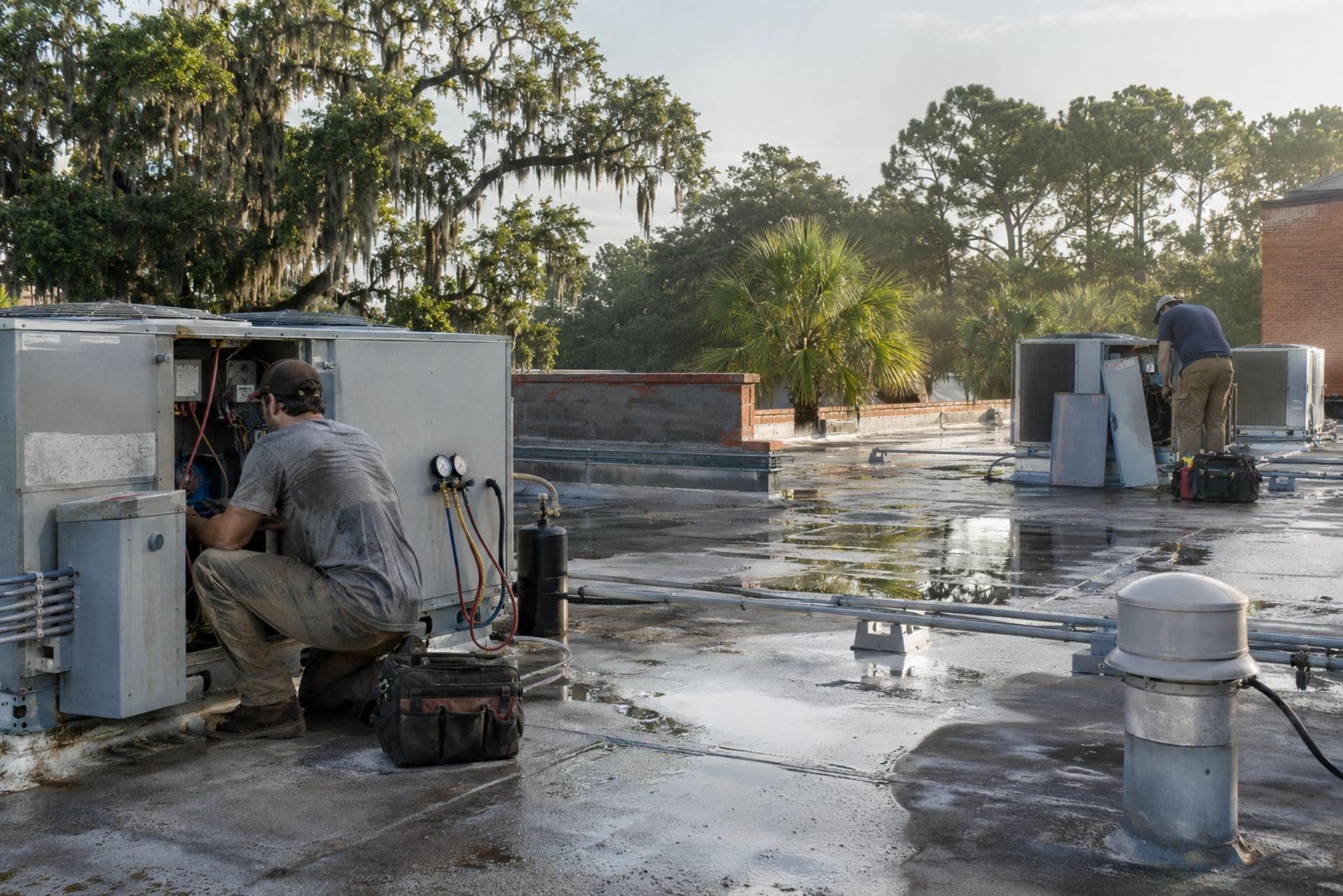
South Carolina requires most employers with four or more employees to carry workers' compensation. That count includes part-time workers, so a shop with two full-time techs and two part-time helpers is already over the line. Agricultural workers and a few other categories are exempt, but HVAC companies aren't among them.
HVAC is a high-injury trade. Back strains from lifting condensers, falls from ladders and roofs, burns from brazing, and electrical shock all show up in claims files. One serious fall can produce months of lost wages and medical bills.
The benefit numbers rose this year. For injuries on or after January 1, 2026, the maximum weekly workers' compensation rate in South Carolina is $1,189.94. Benefits are calculated at 66.6% of the injured employee's average weekly wage, up to that cap.
Here's what that means for you. If a senior tech earning strong overtime gets hurt, the wage replacement bill can climb fast. Without coverage, you'd owe that out of pocket and face penalties from the state.
Misclassifying workers as 1099 contractors is the other common mistake. If you control their schedule, supply the tools, and direct the work, the state may treat them as employees after an injury. Your carrier will also audit payroll at year-end, so keep records clean.
Protecting High-Value Units with Installation Floaters
An installation floater, sometimes called builder's risk for contractors, covers equipment and materials you're installing until the job is finished and accepted by the owner. That's a different exposure from your tools. Tools stay with you. Installation materials become part of someone else's building.
Think about a commercial rooftop unit sitting on a job site in North Charleston for four days before the crane arrives. If it's stolen, damaged by a storm, or dropped during the lift, who pays? Your GL policy won't, because it covers damage to others' property, not the equipment you're responsible for. The customer's property policy usually won't either until it's installed and accepted.
Installation floaters typically cover:
- Equipment in transit from the supplier to the job
- Materials stored on site before installation
- Units during installation, including drops and handling damage
- Theft and weather, subject to policy terms
Size the limit to your largest single job, not your average job. A residential shop doing mostly 3-ton split systems might be fine with a modest limit. A commercial outfit setting multiple package units or a chiller needs far more. Ask whether the policy covers temporary storage locations, since many techs stage equipment overnight at the shop or a separate yard.
Comparing Coverage: Essential vs. Comprehensive Protection
Not every HVAC company needs every endorsement on day one. A solo residential service tech has different needs than a 20-person commercial installer. The table below shows how a basic package compares to a fuller one.
| Coverage | Essential Package | Comprehensive Package |
|---|---|---|
| General liability | $1M/$2M limits | $1M/$2M plus umbrella |
| Pollution liability | Not included | Refrigerant and mold covered |
| Tools and equipment | Actual cash value | Replacement cost, scheduled items |
| Commercial auto | Liability on owned vans | Plus hired/non-owned, full physical damage |
| Workers' comp | State minimum compliance | Plus employer's liability at higher limits |
| Installation floater | Often skipped | Sized to largest job |
| Best fit | Solo or small residential service | Growing crews, commercial and new construction |
The essential package keeps you legal and covers the most frequent claims. The comprehensive package protects you against the claims that put companies out of business: a mold lawsuit, a dropped rooftop unit, or a multi-vehicle crash.
My rule of thumb: once you start bidding commercial work or carrying more than a couple of installs in inventory at once, the comprehensive column stops being optional. GCs and property managers will require much of it in their contracts anyway.
What Determines HVAC Insurance Costs in the Palmetto State?
Insurers price HVAC risk using a handful of factors, and most of them you can influence. Annual revenue and payroll drive GL and workers' comp premiums directly. Your mix of work matters too: residential service is usually cheaper to insure than new construction or commercial rooftop work.
Location plays a role. Coastal counties may see higher property and equipment rates due to storm exposure. Urban areas with heavy traffic, like Columbia and the Upstate corridor, tend to push commercial auto pricing up.
Impact of Claims History and Business Size
Your loss runs, the report of past claims, are the first thing an underwriter checks. A clean three-to-five-year history earns better pricing. Two or three small GL claims in a row can raise your rates more than one large claim, because frequency signals a pattern.
Business size cuts both ways. Bigger crews mean more payroll and more vehicles, so total premium rises. That said, larger shops with formal safety programs sometimes earn better rates per employee than small operations with no documented training. For workers' comp, your experience modification rate (EMR) kicks in once you hit certain premium levels. An EMR below 1.0 lowers your cost. Above 1.0, you pay more.
Ways to Lower Your Annual Premiums
You can bring premiums down without stripping out coverage you'll need:
- Bundle GL and property into a business owner's policy (BOP) where you qualify
- Raise deductibles on tools and auto physical damage if you have cash reserves
- Run MVR checks on every driver before they touch a van
- Install telematics on fleet vehicles; some carriers credit it
- Document safety training for ladders, lifting, and brazing
- Collect sub certificates every time, so your auditor doesn't charge you for uninsured subs
- Shop every two to three years with an independent agent who quotes regional and national carriers
- Pay annually
instead of monthly to avoid installment fees
South Carolina Licensing and Insurance Requirements
South Carolina regulates HVAC work through the Department of Labor, Licensing and Regulation (LLR). Depending on the scope and value of your work, you'll operate under either a residential specialty registration or a mechanical contractor license with an air conditioning, heating, or packaged equipment classification.
Insurance and licensing connect at several points. Workers' comp is required by state law once you meet the employee threshold, whether or not your license application asks for proof. Commercial auto liability is required for any vehicle on the road. GL isn't universally mandated by statute for every license type, but contracts, permits, and municipal requirements frequently demand it.
Meeting LLR Standards for Mechanical Contractors
Mechanical contractor licensing in South Carolina involves financial requirements, exams, and license groups tied to the dollar value of projects you can take on. Higher license groups let you bid bigger jobs but come with stricter financial standards.
Requirements change, so verify current rules directly with LLR before applying or renewing. Keep these documents ready:
- Certificate of insurance for GL and workers' comp
- Proof of financial standing at the level your license group requires
- Exam results for the trade and business portions
- EPA Section 608 certification for anyone handling refrigerant
One practical tip: keep certificates of insurance current and easy to send. Many local building departments and nearly every GC will ask before issuing permits or contracts. Expired certificates stall jobs.
Common Questions About HVAC Coverage in SC
Do I need workers' comp if I'm a one-person HVAC business? Generally no, South Carolina's requirement starts at four employees. Many solo operators still buy a policy because GCs often require it before letting you on a job site.
Does general liability cover refrigerant leaks? Usually not. Most GL policies have a pollution exclusion, so you'll need a pollution liability endorsement to cover refrigerant releases and mold claims.
Can I use my personal truck insurance for service calls? It's risky. Personal policies often exclude vehicles used mainly for business, so a commercial auto policy or hired and non-owned coverage is the safer route.
How much does HVAC insurance cost in South Carolina? General liability for a small crew of 2 to 5 employees typically runs $800 to $2,000 per year. Your total package with auto, comp, and equipment coverage will be higher, depending on payroll and vehicles.
What's the difference between a tools floater and an installation floater? A tools floater covers equipment you own and carry from job to job. An installation floater covers units and materials you're installing until the customer accepts the finished work.
Will a claim from last year raise my premium? It can, especially if you've had several small claims. Underwriters weigh frequency heavily, so preventing repeat incidents matters as much as limiting big losses.
Making the Right Choice for Your HVAC Company
The right insurance setup for your HVAC company follows the work you actually do. General liability with pollution coverage handles customer damage. A tools floater and commercial auto keep your gear and vans protected on the road. Workers' comp meets state law and protects your crew, and an installation floater covers expensive units before they're signed off.
Costs are climbing this year, especially for commercial auto, and the 2026 workers' comp benefit cap raises the stakes on every injury. That makes a clean safety record and smart deductible choices worth real money.
Your next step: pull your current policies, check them against the comparison table above, and list every gap. Bring that list to an independent agent who understands South Carolina HVAC work. Twenty minutes of review now beats discovering an exclusion after the subfloor is already soaked.
About The Author:
David Ashton
As Owner and Agent at Southern Insured, I’m passionate about helping families and businesses in South Carolina find coverage that truly fits their needs. With a background in accounting and years of experience as an independent agent, I value the freedom to recommend what’s best for each client. I enjoy spending time with my wife and children, volunteering at my church, and exploring everything the Upstate has to offer.




Personal Insurance Solutions to Protect Your Self & Family
MANAGE YOUR PERSONAL RISK







We love our clients


Sarah Gibbs
Commercial Insurance Client

Couldn't be happier! If you're looking for home insurance. look no further, The Southern Insurance Group is a great place to get insurance. They really go above and beyond helping you find the best bang for your buck. We own a rental business and a construction company, First Choice Constructors, and Rachel did a great job helping our company find exactly what we needed. Even when her phone was broken, Rachel sent texts and emails communicating clearly and efficiently. She's a true gem to The Southern Insurance Group. It's a pleasure doing business with them.

Mark H.
Personal Insurance Client
Peyton was a much needed change from my last agent who didn’t serve me very well. Peyton is a breath of fresh air. I have all my business insurances through him and loved that he made it much easier than I expected! Definitely recommend!

Cristal N.
Personal Insurance Client
Rachel was very helpful, answered all our questions, talked to the salesman we were buying the car from, and had everything ready to go for a totally new policy within an hour.
The next day we had our older car added to the policy as well, it was quick, easy and friendly. We will be doing all our future car insurance needs through Rachel.

Sabrina C.
Commercial Insurance Client
David Mosely was so helpful! He walked me through my policy and my options and truly could not have been more helpful. I don't know anyone else who would say they enjoyed their experiences trying to find insurance, but with his help I not only got insured, but learned about exactly what I am paying for.

Alex
Personal Insurance Client
Rachel at Southern Insurance Group is great. She is super helpful and nice. This is my go to place for commercial truck insurance in Greenville, SC.

Stephanie M.
Personal Insurance Client
Working with David was amazing! He explained different coverage options and what they all meant which allowed us to make informed decisions based on our needs. His knowledge around insurance is phenomenal and he’s a fun person to talk to. I highly recommend!!
Commercial Insurance Solutions to Protect Your Business
THE BEST INSURANCE COVERAGE FOR YOUR BUSINESS






Industries We Serve
WE PROTECT THESE BUSINESS IN SOUTH CAROLINA, NORTH CAROLINA, & GEORGIA
Contractors
Covers liability, property damage, and worker's compensation for contractors.
Restaurants
Protects against property damage, liability, and business interruption for restaurants.
Real Estate Investors
Safeguards investment properties from damages, liability, and income loss.
Insurance News and Insights
BLOG UPDATES



Support, answer and help, get in touch
Address office
5 Century Dr #130, Greenville, SC 29607
1901 Main Street, Floor 18
Columbia, SC 29201
Mailing Address
PO Box 202 Greenville, SC 29602
Greenville, SC
864-626-6181